
Hello from TIUMLAB.
TIUMLAB Co., Ltd. has started a new project with Keimyung University's AI & Information Office. As a pilot program of the Office, we are developing the AI Thesis Review Service, which helps graduate students check the citations and references in their thesis themselves before submission.
The project runs from September to December 2026 and continues through a first pilot that measures how accurately the service detects formatting errors, using real theses as samples.
Background
Citations and references are one of the most time-consuming parts of finishing a thesis. The rules change with the type of source, the number of authors and whether there is a DOI, and at Keimyung University's Graduate School each department specifies its own writing style, so this is an area where students often go wrong. Formatting checks fall to students and their advisors, so students needed a tool to check their own work before submission.
At the first meeting in August we set the direction: upload a Hangul (hwpx) file, and the service marks what breaks the agreed format and explains why.
How we worked out the requirements
Requirements analysis ran in six stages, from the kickoff meeting to setting the review criteria. Each stage produced its outputs from university material and what we confirmed with staff, and the next stage built on those outputs.

| Stage | When | What we did |
|---|---|---|
| Kickoff meeting | August | Gathered the functions needed and set the direction: mark formatting violations and give the reason |
| Regulation analysis | Aug–Sep | Analysed departmental regulations and mapped which writing style each department specifies |
| Staff interviews | September | Reviewed the current checking process with the Graduate School and the AI & Information Office, and refocused the pilot on whether the review is useful and accurate |
| Deriving review items | September | Organised 29 review items into seven groups, sent them to the university and set implementation priorities from its feedback |
| Confirming requirements | September | Wrote the requirements definition and pilot screen scenarios with 11 usage scenarios, confirmed by the university on September 22 |
| Setting review criteria | October | Checked the review items against the official APA 7th edition sources and added acceptance rules where Korean practice differs from APA for Korean-language sources, for a total of 166 items |
The staff interviews settled the following.
| Item | Decision |
|---|---|
| What is reviewed | In-text citations, references, notes, and spelling and typos |
| Result report | A PDF recording each error's location and suggested notation, the thesis's total page count and the reviewed file's hash |
| Pilot material | Theses published in the library with consent for public release, and theses used with separate consent |
| Pilot method | Detection accuracy measured against test copies of sample theses with injected errors and their answer sets |
Schedule
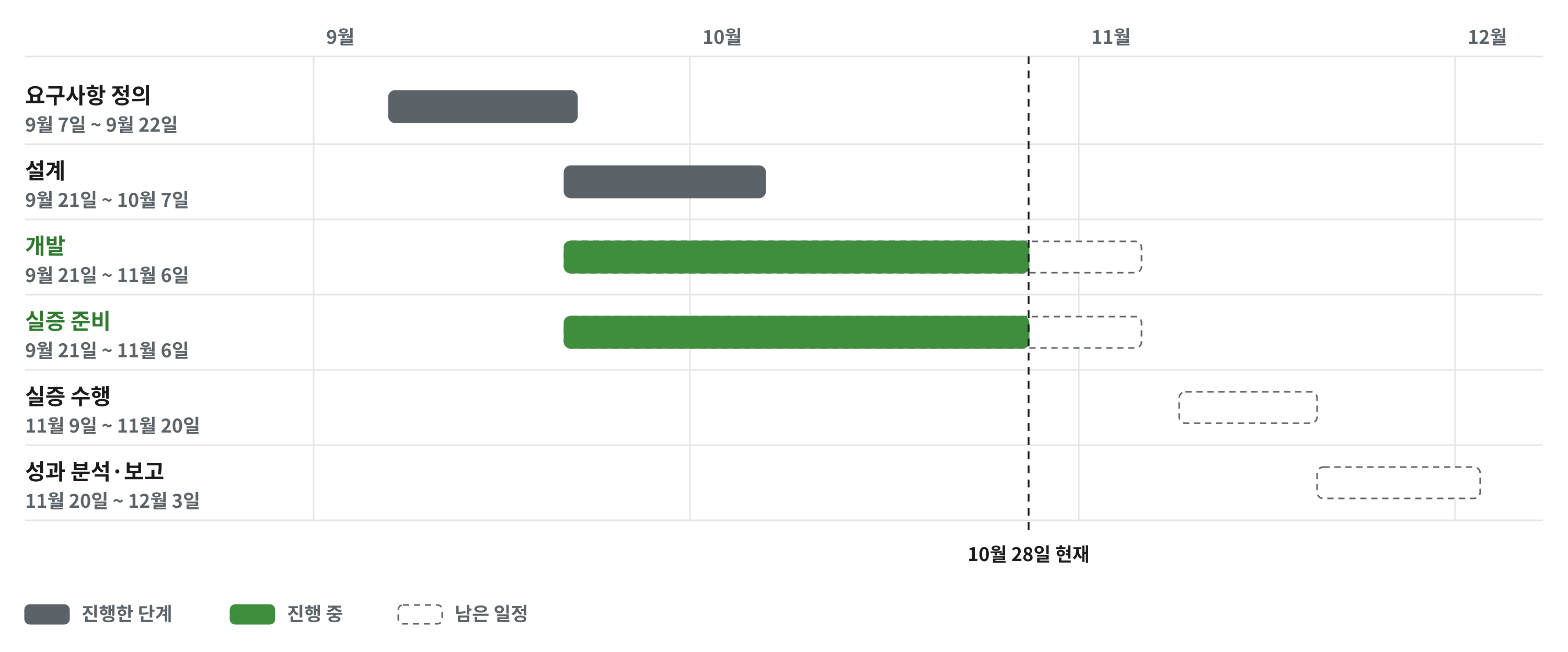
The program runs in six phases: requirements, design, development, pilot preparation, the pilot itself, and analysis and reporting. The chart shows what had been done as of October 28 and what remains.
The first build was completed in October. Upload a thesis as an hwpx file and the review runs through document analysis, citation and reference extraction, item checks and result generation, then marks violations and items to check on the original. Each item comes with the reason and a suggested notation, and the result report can be downloaded as a PDF.
In November we will run the pilot on sample theses and measure detection accuracy, and in December we will compile the results into the final report. We'll share how the pilot goes in a future post.